
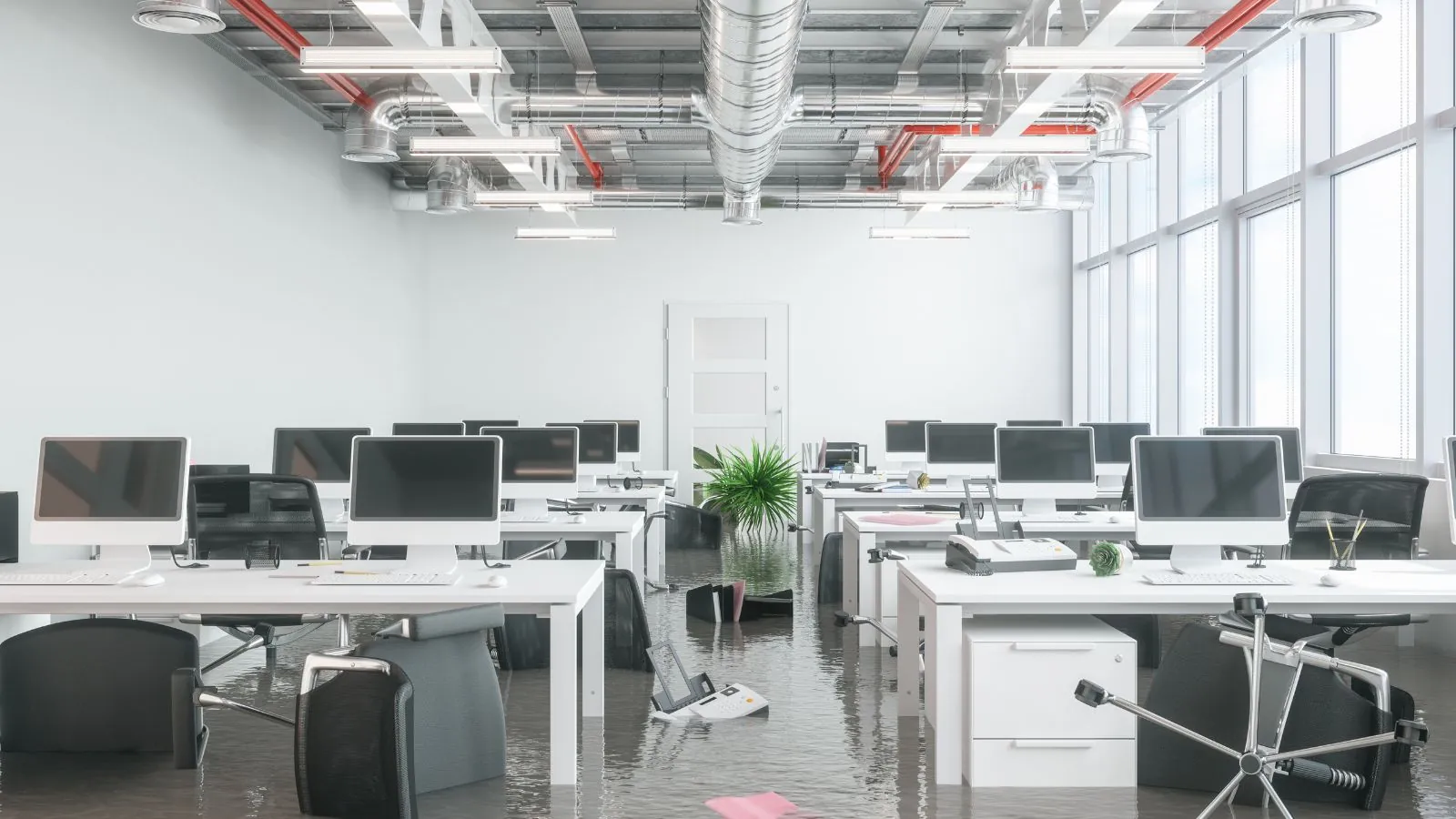
When a business water loss is an emergency
A burst line in a ceiling, a sprinkler failure or a roof leak over inventory turns into an emergency quickly. Downtime stacks up, and so does damage to stock, equipment and records. The phone line is open 24/7, so a call at midnight gets the same attention as a call at noon.
For a commercial loss, the published ANSI/IICRC S500 standard is the usual reference, because it describes how a crew classifies the water, sets drying goals and records moisture readings until the structure reaches them.
While you wait, protect people first. Move customers and staff away from wet floors and any area where water meets electrical equipment. If you can reach the main water valve safely, shut it off. Cover or lift inventory and records, and take photographs before anything is moved.
Power, water and commercial buildings
Do not touch panels, cash registers or office equipment that has been in water. If the water is near a main panel or sub panel, cut power only if the panel itself is dry and reachable, and call the utility or 911 for any electrical or gas concern first.
If the building has a fire sprinkler system that has discharged, call the fire department and your fire alarm company before anyone restarts the system.
What commercial work looks like
Commercial jobs differ from houses in size and in constraints. Floors may be sealed concrete, vinyl tile or carpet tile over a slab. Walls hold insulation and utilities, and ceilings may be lay-in tile with piping above. A business also needs to keep operating, so work is often staged to leave part of the space usable.
Assess and document
A technician walks the space, maps wet areas with moisture meters and photographs conditions.
Extract and protect
Water is removed and contents are moved, covered or packed out of the wet zone.
Dry the structure
Air movers and dehumidifiers are placed by moisture mapping, not guesswork.
Scope and report
A written scope separates drying from repair so owners, managers and insurers can follow it.
Business losses we see most often
| Building type | Frequent cause | What matters most |
|---|---|---|
| Office or suite | Ceiling line, HVAC drain overflow, restroom supply line | Speed to dry and returning rooms to use |
| Retail or restaurant | Dishwasher or ice machine line, roof leak, drain backup | Contents, food safety and reopening date |
| Multi-unit or rental building | Water from an upper unit, water heater failure | Which units are affected and who is responsible |
| Church, school or community space | Roof or gutter failure, restroom flooding | Large floor area and use schedule |
Multi-unit buildings often involve more than one policy and more than one party. Good records make that easier, which is why the written scope lists rooms, materials, equipment and drying days in plain language. Many commercial losses start as a ceiling leak or a failed line, and the cleanup steps resemble those for homes, only larger.
Cost factors for a commercial water loss
A fair estimate for a business depends on facts that only a walkthrough can confirm. These are the main ones:
- Total square footage affected and the number of floors
- Water category, with sewage or flood water costing more to clean
- Floor and wall materials, such as concrete, tile, carpet tile or drywall
- Equipment count and the number of drying days
- Contents handling, such as moving inventory or furniture
- Repair work left after drying, such as ceiling tile or drywall
For a business, call (833) 521-1033 and describe the building, the water and who is affected.
Commercial property policies vary widely, and business interruption coverage is separate from damage coverage on many policies. Commercial property policies vary widely, and business interruption coverage is separate from damage coverage on many of them. Sudden accidental losses are often covered, gradual leaks and poor upkeep often are not, and flood needs its own coverage, so ask your agent which parts of your policy apply.
Where we work
Commercial calls come from along SR 502 and SR 503 in Battle Ground, from Old Town storefronts and from nearby communities including Vancouver, Brush Prairie, Yacolt and La Center. For storefronts on East Main Street, see how we approach Old Town properties with older construction.
If your loss began with standing water, water extraction explains the first stage in more detail. Rental owners should also read how we handle appliance leaks that start in one unit and reach another.
Questions people ask
Do you handle commercial water damage emergencies at night or on weekends in Battle Ground?
Yes. Business losses often start after closing, and the line is open 24/7 for them. Describe the building, where the water is and whether power is affected, and we will explain what to do while a crew is arranged.
Can work be done while my business stays open?
Often, yes. Work can be staged so part of the space stays usable, with containment and walkway protection. It depends on the size of the loss, the water category and what your staff and customers need to access.
What records do I need for a commercial insurance claim?
Photographs of damage before cleanup, a list of damaged contents, the date and cause of the loss, and the written scope and moisture readings from the drying work. Ask your insurer which forms it requires.
Do you work in multi-unit buildings?
Yes. Multi-unit losses need a clear map of which units and shared spaces are affected. The scope notes each room so owners, managers and tenants can see what happened where.
Can you handle a sprinkler or fire suppression discharge?
Water from a sprinkler discharge can be extracted and dried like any other. Call the fire department and your fire alarm company first, since the system must be inspected and reset by qualified people.